TeamUniversal Basic Nutrient Income


Positiva Pengar ↗ is a non-profit, politically independent civil-society movement working to reform the monetary system so that money serves people, society, and the environment rather than the interests of private finance. As the Swedish branch of the International Movement for Monetary Reform, it unites economists, researchers, activists, and citizens from across the political spectrum in the pursuit of a fairer, greener, and more stable economy.
Through education, research, and public advocacy, the movement makes the hidden mechanics of money and banking legible — challenging the reality that nearly all money today is created by private banks through lending, with consequences like rising asset prices, widening inequality, and recurring financial crises. Its work targets the “dark matter” of the economy: the rules governing how money is created, and who holds the power to decide.
Dark Matter Labs ↗ is a strategic research and design organization working to reimagine the foundational systems — legal, financial, institutional, and governance — that shape our societies.
Through a portfolio of experimental projects, the lab collaborates with cities, governments, and philanthropic institutions to prototype regenerative infrastructure, advance mission-oriented innovation, and unlock systemic transformation. Its work focuses on addressing the “dark matter” of systems change: the hidden rules, norms, and power structures that underpin how we organize, govern, and invest in our collective future. DML worked with a broad range of organizations including EEA, UN FAO, UNDP, national governments and ministries, bioregions, municipalities and food philanthropies.
MiljöMatematik Malmö ↗ is a purpose-driven, non-profit-oriented enterprise working at the intersection of science, business, and sustainability, with a central focus on regenerative food systems. Its driving purpose is to contribute to a flourishing economy and society operating within planetary boundaries.
Using mathematics as its core methodology and a cross-disciplinary, innovation-led approach, the company makes research and development accessible and actionable across the private and public sectors. Its work spans consultancy, applied modelling, and pioneering initiatives such as Sweden’s first programme for carbon sequestration in agricultural soils — all anchored in regenerative principles that aim to move the food system beyond incremental efficiency toward solutions that actively restore the living systems they depend on.

Samuel Färdow Kazen
Samuel Färdow Kazen is an analyst and researcher active in Positiva Pengar and the International Movement for Monetary Reform. He authored the Katalys report “Förstatliga pengarna” (Nationalise the Money) and is a frequent op-ed writer in Swedish outlets including Dagens Industri, Ekonomisk Debatt, Dagens Nyheter, Realtid, and Svenska Dagbladet, arguing for monetary reform, a digital e-krona, and greater democratic control over money creation. He is a regular speaker and panel leader at the movement’s public campaigns, including its annual presence at Almedalen.
samuel.kazen@positivapengar.se

Aleksander Nowak
Aleksander Nowak is a strategic designer, researcher, data analyst and architect, with expertise in data visualisation and spatial and system mappings. His main area of research within Dark Matter Labs and the Urbanism and Societal Change programme (KADK, Copenhagen) has focused on food systems, biodiversity and finance, and on visual methods as participatory tools that aid societal and sustainable change.
aleks@darkmatterlabs.org

Jessica Johansson
Jessica Johansson is a senior transition consultant at MiljöMatematik, working with actors across the entire food value chain. She works alongside farmers and researchers to explore how agriculture can help increase carbon sequestration, and is a project lead on Svensk Kolinlagring, Sweden’s first programme for carbon sequestration and transformation of agricultural land. She is passionate about educating others, conveying a systems perspective, and making the complex understandable — driving food-system transformation through innovation and work at the systems level.
jessica.johansson@miljomatematik.se

Gino Carciola
Gino Carciola is a transition consultant at MiljöMatematik and an expert in the frameworks and standards around sustainability reporting and certification. He brings experience in sustainability advisory work for food companies, with a particular focus on One Planet Plate, the WWF meal concept for which he leads one of the initiative’s two hubs. He has represented the organisation’s carbon-sequestration work publicly, including accepting the Lions environmental and sustainable-development prize on its behalf.
gino.carciola@miljomatematik.se
How can municipalities build food sovereignty, resilience and preparedness through economic and monetary instruments?
If you are aMunicipal official
responsible for public meals, procurement, land, preparedness, social support or local development — this report is primarily written for you. It maps the economic tools already within your mandate and shows how they can be combined into a local food transition strategy.

If you are aRegional Authority
working in public health, healthcare financing, regional development or infrastructure — this report shows how food-system investment at the regional level can reduce healthcare costs, build resilience and coordinate what municipalities are doing on the ground.
If you are aNational policymaker, central bank official or parliamentarian
this report proposes the enabling infrastructure: the frameworks, fiscal and monetary tools that make local and regional action scalable and coherent.
If you are aProducer, cooperative, food hub, impact investor or civil society organisation
this report maps the policy environment that could support your work, and the economic circuits you could become part of.
Together, these tools can help build economic circuits that keep value circulating locally, reward sustainable behaviour, strengthen resilient food systems and mobilise resources for transition.
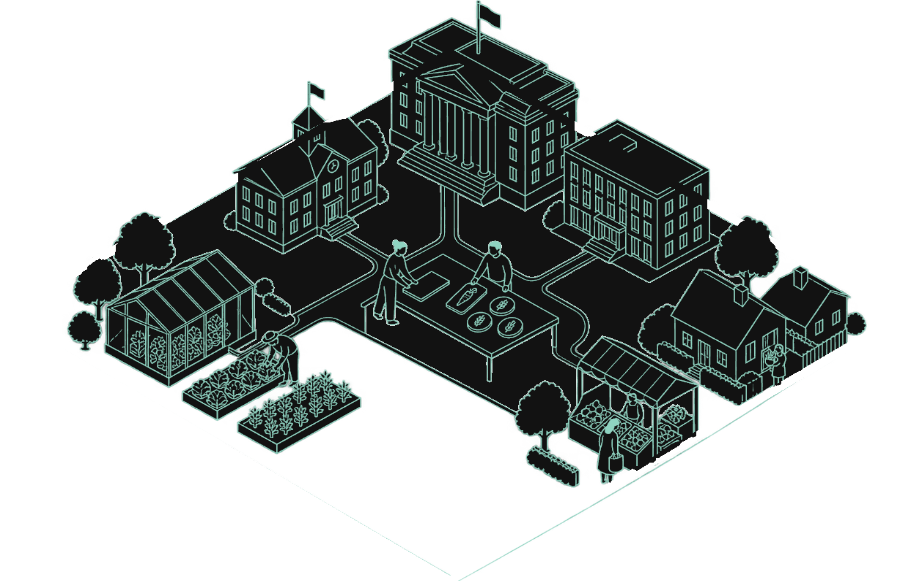
Join the economic and monetary food revolution
The mainstream food system’s economic logic externalises costs, extracts value from rural economies and misprices risk — making fragile, import-dependent supply chains appear efficient while resilient, regenerative alternatives struggle to compete.
The transformation toward a sovereign food system is necessary and it’s already beginning.
We explore economic and monetary tools that can make money “serve” food and eventually “serve” human and ecosystem well-being.
The report
The full report is reserved for those who register for exclusive early access.
From food-system challenges to practical instruments
- Why the current food economy struggles to reward resilience, health and local value.
- Economic tools municipalities can use in procurement, preparedness and local food production.
- How regional and national policy and monetary design can support local action.